

In recent years, psychological mystery and atmospheric suspense stories have grown dramatically in popularity. Readers today are looking for more than fast action or predictable plot twists. They want emotional depth, immersive environments, and stories that stay with them long after the final page.
Psychological mystery novels answer that need by combining suspense, emotional storytelling, and deeper philosophical themes about memory, identity, and reality.
More than ever, readers are drawn to stories that reflect the complexity of the modern world. In an era shaped by constant information, shifting perspectives, and digital identities, psychological mystery fiction offers something rare: emotional truth hidden inside uncertainty.
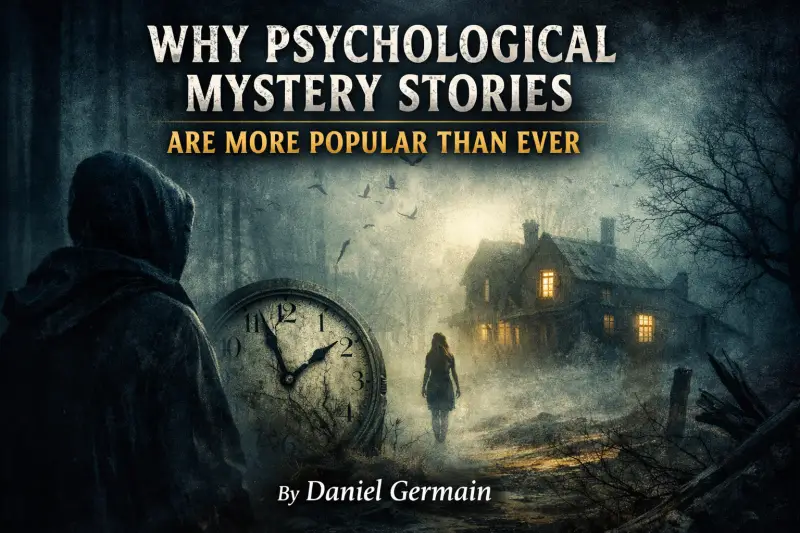
Why Readers Connect So Strongly With Dark Atmospheric Stories
Dark mystery stories activate curiosity and emotional engagement simultaneously.
Readers often report feeling:
-
Deep immersion in the story world
-
Emotional attachment to characters
-
Lingering curiosity after finishing the book
-
Desire to revisit the story for hidden clues
Atmosphere plays a key role. Settings such as abandoned towns, foggy forests, or forgotten locations create psychological tension that enhances storytelling impact.
From a psychological perspective, uncertainty activates the brain’s pattern-recognition systems. Humans are naturally wired to search for meaning and explanation. When a story withholds complete answers, it creates a cognitive tension that keeps readers engaged.
This is why atmospheric mystery often feels more emotionally powerful than action-driven storytelling. Instead of relying on external danger, psychological mystery explores internal fear — fear of losing identity, fear of forgotten truths, or fear that reality may not be as stable as we believe.
Research from the British Psychological Society indicates that engaging with mystery narratives stimulates both cognitive problem-solving and emotional imagination, offering insight into why readers remain deeply invested in unresolved stories.
Memory, Time, and Identity: Core Themes in Modern Mystery Fiction
Many modern mystery novels explore deeper themes such as:
Memory
How reliable are our memories?
What happens when memories change or fade?
Time
Is the past truly gone, or does it continue influencing the present?
Identity
If memories shape who we are, what happens when they are altered?
These philosophical questions elevate mystery fiction from entertainment to experience.
Modern readers are particularly drawn to stories that explore subjective reality. Social media, digital identities, and constant information exposure have changed how people perceive truth and memory. Psychological mystery fiction mirrors this uncertainty, creating narratives that feel both fictional and emotionally real.

Psychological Mystery in Modern Culture
Today’s cultural landscape has made psychological mystery more relevant than ever. People are constantly exposed to different versions of reality through social media, news feeds, and digital environments. The line between perception and truth can sometimes feel blurred.
In many ways, psychological mystery fiction reflects this experience. Stories built around unreliable narrators, fragmented memories, or hidden past events mirror how modern audiences sometimes feel about real life — uncertain, searching for clarity, and trying to piece together meaning from incomplete information.
The global pandemic also changed how people relate to isolation, fear, and uncertainty. Readers became more open to introspective storytelling and emotional depth. Psychological mystery fiction, with its focus on internal conflict and emotional tension, naturally connects with these shared human experiences.
As technology continues to evolve, storytelling will likely explore even deeper questions about identity, memory, and perception. Psychological mystery fiction is uniquely positioned to adapt to these cultural shifts because it focuses on what makes us human — our need to understand ourselves and the world around us.
The Power of Environmental Storytelling
In atmospheric psychological fiction, locations are more than backdrops.
They become characters themselves.
Readers subconsciously connect emotions to environments. A silent forest, an abandoned structure, or a forgotten town can trigger tension even before any action occurs.
Environmental storytelling allows writers to communicate emotion without explicit explanation. A location can carry history, trauma, or mystery simply through atmosphere. This cinematic approach to writing is increasingly popular among modern readers who are visually oriented due to film and streaming culture.

The Future of Psychological Mystery Storytelling
Several trends suggest continued growth in psychological mystery fiction.
New storytelling technologies, including immersive audio storytelling, interactive narratives, and AI-assisted creative tools, are pushing narrative boundaries. At the same time, readers are increasingly interested in stories that explore consciousness, perception, and emotional memory.
Themes such as identity fragmentation, digital reality, and hidden psychological trauma are becoming more common in modern storytelling. Psychological mystery is uniquely positioned to explore these topics in ways that feel personal, emotional, and immersive.
Why Psychological Mystery Will Continue Growing
Several trends suggest continued growth:
✔ Increased demand for immersive storytelling
✔ Popularity of streaming mystery series
✔ Reader interest in complex narratives
✔ Growth of supernatural-adjacent psychological fiction
Readers want stories that respect their intelligence and imagination.
As discussed in an article from The Common Reader, the enduring popularity of thrillers, particularly psychological ones, is attributed to their ability to activate fear—a dominant emotion in our current sociopolitical landscape—thereby resonating deeply with contemporary readers.

Final Thought
The most powerful stories don’t just entertain.
They stay alive in the reader’s mind.
Psychological mystery fiction continues to grow because it mirrors real human fears, curiosity, and the desire to understand what lies beneath the surface of reality.
In a world where certainty is increasingly rare, mystery stories offer something deeply human — the opportunity to explore fear, memory, and identity from a safe distance, while still feeling emotionally connected to the unknown.
Frequently Asked Questions About Psychological Mystery Fiction
❓ What is psychological mystery fiction?
Psychological mystery fiction focuses on the inner world of characters — memory, perception, identity, and emotional conflict — rather than only external action or plot twists.
❓ Why are psychological mystery stories becoming more popular?
Modern readers are increasingly interested in stories that reflect emotional complexity, uncertainty, and deeper human questions about reality and identity.
❓ What makes atmospheric storytelling important in mystery fiction?
Atmosphere helps create emotional immersion. Environments such as forests, abandoned towns, or isolated locations can build tension and reinforce psychological themes.
❓ Do psychological mysteries always include supernatural elements?
Not always. Many psychological mysteries focus purely on human psychology, while others blend psychological tension with subtle supernatural or unexplained elements.
❓ Why do readers enjoy unresolved mystery elements?
Unanswered questions stimulate curiosity and imagination, allowing readers to stay mentally connected to the story even after finishing the book.
About the Author
Daniel Germain is a psychological mystery author whose work explores memory, identity, time, and the hidden forces shaping human perception. His stories focus on atmospheric storytelling, emotional depth, and the fragile boundary between reality and illusion.
If you enjoy atmospheric psychological mystery fiction, you may enjoy his novel Echoes of the Forgotten, which explores similar themes through a dark, character-driven narrative where memory and reality are not always what they seem.
Daniel Germain
Add comment
Comments